

When a Calgary homeowner’s furnace stops working at 9 PM on a January evening, they don’t boot up their desktop computer. They grab their phone and search “emergency furnace repair near me.” If your contractor website isn’t optimized for that mobile moment, you’ve already lost the job to a competitor who is.
Mobile-first SEO isn’t just important for home service contractors in Calgary anymore. It’s the foundation of your entire online presence. With over 70% of local home service searches happening on mobile devices in 2026, your mobile experience directly determines whether you show up in search results and whether those searchers become paying customers.
This guide breaks down exactly why mobile-first SEO matters for Calgary contractors and shows you how to optimize your digital presence for the devices your customers actually use.
What Is Mobile-First SEO and Why Does It Matter for Contractors?
Mobile-first SEO means Google primarily uses the mobile version of your website for indexing and ranking. Since March 2021, Google switched to mobile-first indexing for all websites, meaning your mobile site performance directly impacts your search visibility.
For home service contractors in Calgary, this shift changed everything. Google now evaluates your website based on how it works on a smartphone, not a desktop computer. If your mobile site loads slowly, has tiny buttons, or makes it hard to find your phone number, Google ranks you lower than competitors with better mobile experiences.
The numbers tell the story clearly. Research shows that 76% of people who search for something nearby on their smartphone visit a business within 24 hours, and 28% of those searches result in a purchase. For emergency services like plumbing or HVAC repair, mobile search dominance reaches even higher, with some studies showing 82% of urgent service searches happening on mobile devices.
In Calgary’s competitive contractor market, where dozens of plumbers, electricians, and HVAC technicians compete for the same local customers, mobile-first SEO often makes the difference between ranking in the top three local results or disappearing onto page two.
The Current State of Mobile Search for Home Services in Calgary

Calgary homeowners rely heavily on mobile devices when searching for contractors. Recent data from 2026 shows that mobile searches for home services peak during specific times that reveal clear patterns about when people need help.
Emergency service searches spike between 7 PM and 10 PM on weekdays, when homeowners discover problems after returning from work. Weekend mobile searches for non-emergency services peak between 9 AM and 11 AM, when people plan home improvement projects. Understanding these patterns helps contractors optimize their mobile presence for maximum visibility during high-intent moments.
Consumer behavior on mobile differs dramatically from desktop usage. Mobile users overwhelmingly prefer click-to-call over filling out contact forms. Studies show that 70% of mobile searchers use the click-to-call feature to contact businesses directly, while only 30% submit forms. This preference intensifies for emergency services, where nearly 90% of mobile users choose calling over any other contact method.
The average mobile session for contractor searches lasts just 47 seconds. Calgary homeowners make quick decisions on their phones, often contacting the first contractor whose mobile site loads fast, displays a prominent phone number, and clearly shows they service the needed area.
Core Elements of Mobile-First SEO for Home Service Websites
Successful mobile-first SEO for contractors combines technical performance, user experience design, and strategic content placement. Each element works together to create a mobile experience that converts searchers into customers.
Page Speed Optimization for Mobile Users
Mobile page speed directly impacts both your search rankings and your lead generation. Google research shows that 53% of mobile users abandon sites that take longer than three seconds to load. For contractors, every additional second of load time can mean lost emergency service calls worth hundreds or thousands of dollars.
Target a mobile load time under three seconds. Test your current speed using Google PageSpeed Insights and identify specific issues slowing down your mobile site. Common problems include oversized images, render-blocking JavaScript, and unnecessary third-party scripts.
Image compression makes one of the biggest impacts on mobile speed. Service photos that look great on desktop often contain unnecessary file size that kills mobile performance. Use modern image formats like WebP and implement lazy loading so images only load as users scroll down the page.
The business impact of slow mobile sites shows up clearly in analytics. Contractors with mobile load times above five seconds typically see bounce rates exceeding 70%, meaning seven out of ten potential customers leave before seeing any content. Sites loading in under two seconds maintain bounce rates below 40%, capturing significantly more leads from the same search traffic.
Mobile-Responsive Design That Converts
Responsive design ensures your contractor website adapts smoothly to any screen size, but true mobile optimization goes deeper than simple responsiveness. Your mobile design must prioritize the actions mobile users want to take.
Touch-friendly buttons need minimum dimensions of 48×48 pixels with adequate spacing between clickable elements. Mobile users get frustrated when they accidentally tap the wrong button because elements sit too close together. This frustration often sends them to a competitor’s easier-to-use site.
Simplify forms for mobile completion. Long contact forms with many fields perform terribly on mobile devices. Reduce fields to absolute essentials like name, phone number, and service needed. Consider implementing auto-fill functionality and making fields large enough for easy thumb typing.
Place clear calls-to-action above the fold on mobile screens. Your phone number should appear prominently at the top of every mobile page, ideally as a clickable button. Don’t make mobile users scroll or hunt for ways to contact you. The easier you make it, the more calls you receive.
Click-to-Call Functionality and Local Business Schema
Click-to-call buttons transform phone numbers into immediate connection points. Implement tap-to-call throughout your mobile site using proper HTML markup that mobile browsers recognize as phone numbers. This simple addition can increase mobile leads by 50% or more.
Structured data markup helps search engines understand your business information and display it correctly in mobile search results. Local Business schema tells Google your phone number, service areas, hours, and services offered. This data feeds into rich results that make your business stand out in mobile search listings.
Integrate your Google Business Profile seamlessly with your mobile website. Ensure your phone number, address, and business hours match exactly across all platforms. Inconsistent information confuses both search engines and potential customers, reducing your mobile visibility.
Mobile searchers often click your phone number directly from Google search results without visiting your website. Optimize your Google Business Profile with current photos, accurate service descriptions, and regular posts to capture these direct mobile interactions.
How Mobile-First SEO Impacts Local Search Rankings in Calgary
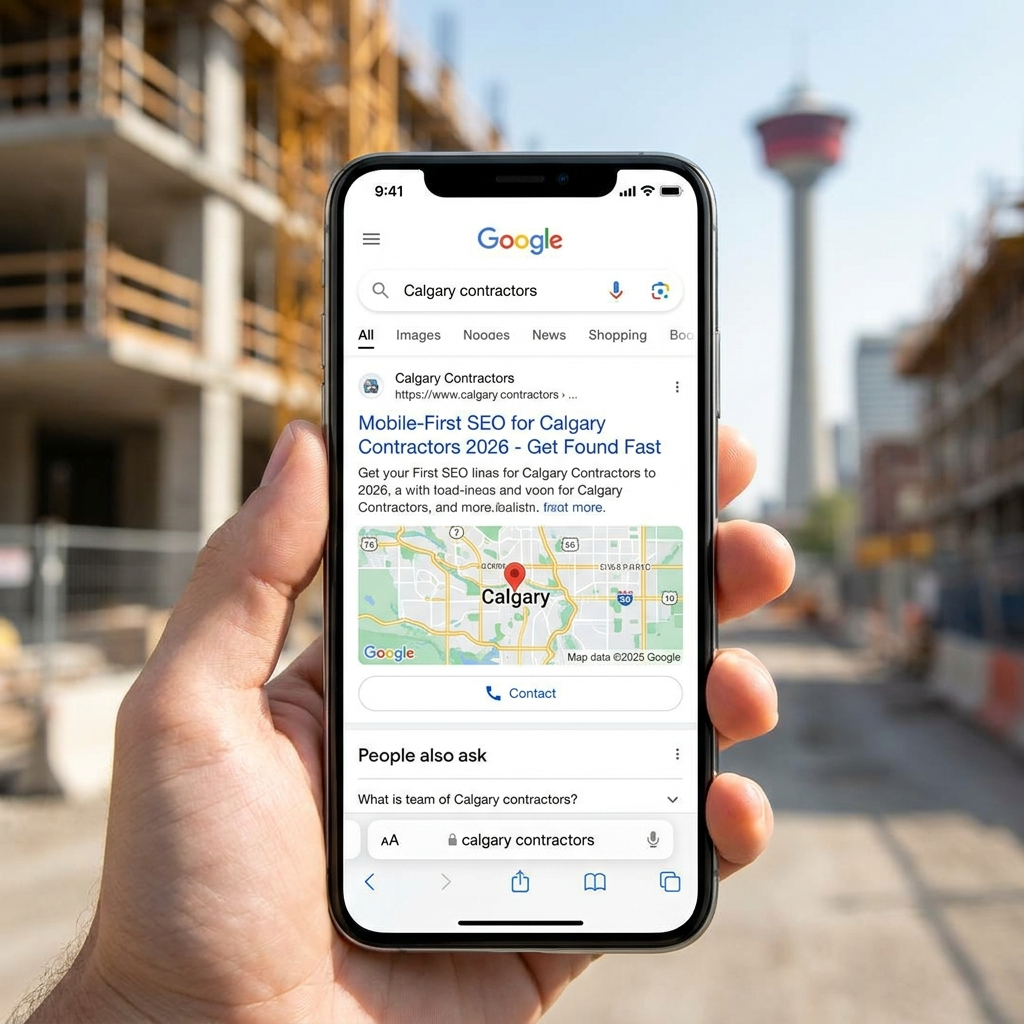
Google’s mobile-first indexing algorithm evaluates hundreds of ranking factors, but several carry special weight for local contractor searches. Mobile user experience signals now influence whether your business appears in the coveted local three-pack that dominates mobile search results.
Mobile usability directly affects local pack visibility. Google analyzes how mobile users interact with your site through metrics like time on page, bounce rate, and task completion. Sites that mobile users quickly abandon signal poor quality to Google, pushing you down in local rankings.
Core Web Vitals measure specific aspects of mobile user experience that Google considers ranking factors. Largest Contentful Paint (LCP) tracks loading performance, First Input Delay (FID) measures interactivity, and Cumulative Layout Shift (CLS) evaluates visual stability. Calgary contractors ranking in top positions consistently score well on all three metrics.
Case studies from Calgary contractors show measurable ranking improvements after mobile optimization. One local plumbing company improved mobile load time from 6.2 seconds to 2.1 seconds and saw their average local pack position improve from 8th to 3rd within six weeks. Their mobile lead volume increased by 145% during the same period.
Another HVAC contractor in Calgary redesigned their mobile site with larger buttons, simplified navigation, and prominent click-to-call placement. Within three months, their mobile conversion rate doubled while their average cost per lead decreased by 35%. These real results demonstrate how mobile-first SEO creates competitive advantages in local markets.
Mobile Content Strategy for Home Service Contractors
Mobile content requires different formatting and structure than desktop content. Calgary homeowners reading on small screens need information presented in easily scannable, digestible chunks that answer questions quickly.
Creating Scannable Content for Mobile Readers
Short paragraphs work best on mobile screens. Aim for three to five sentences per paragraph, creating natural break points that prevent walls of text. Mobile readers skim content rather than reading every word, so structure helps them find relevant information fast.
Bullet points and numbered lists organize information for easy mobile consumption. When explaining your service process or listing service areas, formatted lists allow mobile users to grasp key points at a glance without reading full paragraphs.
Strategic heading use guides mobile readers through your content. Descriptive H2 and H3 headings act as signposts that help users jump to sections matching their needs. A mobile user searching for emergency service should immediately see a heading addressing emergency availability.
Video content engages mobile users effectively when properly optimized. Keep videos under 90 seconds, ensure they play on mobile devices without special plugins, and always include captions since many mobile users watch videos without sound. Showcase your work, explain common problems, or introduce your team through mobile-friendly video.
Location-Specific Mobile Content for Calgary Neighborhoods
Create dedicated service pages for Calgary neighborhoods optimized specifically for mobile viewing. Mobile searchers often include neighborhood names in queries like “plumber in Inglewood” or “electrician Kensington.” Pages targeting these specific searches capture high-intent local traffic.
Mobile-friendly local content answers immediate homeowner questions. Address common problems specific to Calgary homes, like furnace issues during cold snaps or spring flooding concerns. This relevant local content positions you as the neighborhood expert while naturally incorporating location-based keywords.
Embed Google Maps in your mobile pages to help customers find you easily. Mobile users can tap the embedded map to get immediate directions. This functionality proves especially valuable for emergency services when customers need to know you can reach them quickly.
Include Calgary-specific references that resonate with local searchers. Mention landmarks, neighborhoods, and local considerations that demonstrate your knowledge of the area. This localized approach improves relevance for both search engines and potential customers.
Technical Mobile SEO Essentials for Contractor Websites
Technical mobile SEO involves behind-the-scenes optimization that ensures search engines can properly crawl, index, and rank your mobile site. These technical elements create the foundation for all other mobile SEO efforts.
Mobile-friendly testing tools help identify issues preventing optimal mobile performance. Google’s Mobile-Friendly Test analyzes your pages and reports specific problems like text too small to read, clickable elements too close together, or content wider than the screen. Fix these issues to improve both user experience and search rankings.
Accelerated Mobile Pages (AMP) create lightweight versions of web pages that load almost instantly on mobile devices. While AMP benefits publishers and blogs most directly, some service contractors use AMP for blog content and informational pages. The speed benefits can improve mobile engagement, though implementation requires technical expertise.
Common mobile usability issues hurt Calgary contractor rankings more than many realize. Blocked JavaScript, CSS, or images prevent Google from rendering your mobile pages correctly. Intrusive interstitials that cover content frustrate users and trigger ranking penalties. Small font sizes force mobile users to zoom, creating poor experiences that Google notices.
Core Web Vitals optimization requires ongoing attention as Google continues refining these metrics. Monitor your mobile Core Web Vitals through Google Search Console and address issues systematically. Improving these metrics often requires technical changes to hosting, caching, code structure, and resource loading.
Voice Search and Mobile: The Connected Experience

Voice search and mobile search connect intimately since most voice searches happen on mobile devices. Calgary homeowners increasingly use voice assistants to find contractors while driving, cooking, or handling other tasks.
Mobile users trigger voice searches for home services when typing feels inconvenient. Someone discovering a leaking pipe while washing dishes might say “Hey Google, find a plumber near me open now” rather than stopping to type. Your mobile SEO strategy must account for these conversational queries.
Optimize for conversational search phrases that match how people actually speak. Voice queries tend longer and more specific than typed searches. Instead of just “Calgary plumber,” voice searchers say “Who’s the best emergency plumber in Calgary available right now?” Include these natural language phrases in your mobile content.
Featured snippet optimization helps your content appear in voice search results. Google often pulls voice search answers from featured snippets, those boxed answers appearing at the top of mobile search results. Structure content to directly answer common questions in concise paragraphs that Google can extract easily.
Question-based content performs well for both mobile and voice search. Create FAQ sections addressing specific questions Calgary homeowners ask about your services. These Q&A formats align perfectly with how voice search queries get structured.
Tracking Mobile SEO Performance and ROI
Measuring mobile SEO success requires tracking specific metrics that show how mobile optimization impacts your bottom line. General website metrics don’t reveal the full picture of mobile performance.
Google Analytics 4 provides detailed mobile metrics showing how mobile users interact with your site differently than desktop users. Track mobile-specific bounce rates, conversion rates, and average session duration. Compare these metrics between mobile and desktop to identify optimization opportunities.
Mobile conversion tracking captures calls, form submissions, and booking requests originating from mobile devices. Set up event tracking for click-to-call buttons to measure how many mobile visitors actually call your business. This data reveals your true mobile ROI more accurately than page views or traffic alone.
A/B testing strategies for mobile landing pages help optimize conversion elements systematically. Test different button placements, headline variations, and form designs to discover what mobile users respond to best. Even small improvements in mobile conversion rates compound into significant lead increases.
Measure mobile versus desktop lead quality to understand which device type produces better customers. Some contractors find mobile leads convert to jobs at higher rates despite shorter initial sessions. Others discover desktop leads represent larger projects while mobile generates more emergency calls. Track these patterns to refine your mobile strategy.
Common Mobile SEO Mistakes Calgary Contractors Make
Many Calgary contractors unknowingly sabotage their mobile performance through common mistakes that push them down in local search rankings. Recognizing and fixing these issues creates immediate competitive advantages.
Intrusive interstitials and pop-ups damage mobile rankings significantly. Google specifically penalizes mobile sites using pop-ups that cover main content, especially on pages users arrive at from search results. That newsletter signup pop-up might work on desktop but kills your mobile rankings.
Unplayable content and blocked resources prevent Google from properly evaluating your mobile site. Some contractors accidentally block CSS or JavaScript files that make their mobile site function correctly. Others embed videos or content that won’t play on mobile devices, frustrating users and signaling poor quality to search engines.
Poor mobile navigation increases bounce rates dramatically. Complicated menus, hidden navigation, or too many choices overwhelm mobile users who want simple, direct paths to information. Streamline mobile navigation to essential pages and clear calls-to-action.
Ignoring mobile-specific keyword opportunities costs contractors valuable traffic. Mobile searches often include different phrases than desktop searches, with more urgency indicators and location modifiers. Research mobile search patterns specifically rather than assuming desktop keywords work equally well on mobile.
Future-Proofing Your Mobile SEO Strategy in Alberta’s Market
Mobile search continues evolving as technology advances and consumer behavior shifts. Calgary contractors who prepare for these changes now will maintain competitive advantages as the market develops.
Emerging mobile search technologies include visual search, augmented reality previews, and enhanced local discovery features. While not all apply to every contractor business, staying aware of these trends helps you identify relevant opportunities early.
Integration of AI-powered mobile experiences will change how customers discover and interact with contractor businesses. ChatGPT, Google’s AI overviews, and other AI systems increasingly answer questions directly rather than just listing search results. Optimizing content for these AI systems requires the same clear, authoritative, question-answering approach that benefits traditional SEO.
The Truth Protocol™ methodology provides comprehensive frameworks for mobile-first optimization within broader digital marketing strategies. This systematic approach ensures mobile optimization integrates properly with overall SEO, content marketing, and conversion optimization rather than existing as an isolated tactic.
Staying competitive as mobile search dominates requires ongoing optimization and adaptation. Mobile technology, user expectations, and search algorithms all continue changing. Contractors who view mobile SEO as an ongoing practice rather than a one-time project maintain their visibility as competitors fall behind.
Regular mobile audits identify new issues before they impact rankings. Test your mobile site quarterly using various devices and connection speeds. Monitor mobile analytics for concerning trends. Keep content fresh and technically sound to maintain strong mobile performance.
Frequently Asked Questions
How does mobile-first SEO differ from traditional SEO for home service contractors?
Mobile-first SEO prioritizes the mobile user experience in all optimization decisions, while traditional SEO often focused primarily on desktop performance. Mobile-first means designing for smaller screens first, emphasizing click-to-call over forms, optimizing for faster load times on cellular connections, and structuring content for quick mobile scanning. Since Google now uses mobile versions of sites for indexing and ranking, mobile-first SEO has become the standard rather than a separate strategy.
What is the average mobile site speed for top-ranking Calgary contractors?
Top-ranking Calgary contractors in 2026 typically achieve mobile load times between 1.8 and 2.5 seconds. Sites loading faster than three seconds consistently outperform slower competitors in local search rankings. The fastest contractor sites in Calgary load core content in under two seconds, though achieving this speed requires dedicated optimization including image compression, efficient code, quality hosting, and proper caching.
Can I rank well locally if my website isn’t mobile-optimized?
Ranking well without mobile optimization has become nearly impossible in 2026. Since Google uses mobile-first indexing, a poor mobile experience directly damages your rankings even for desktop searches. Competitors with optimized mobile sites will consistently outrank you in local searches. Additionally, even if you somehow achieved rankings, the poor mobile experience would cause most visitors to leave immediately, wasting your visibility on leads that go to competitors.
How much does mobile optimization cost for a contractor website?
Mobile optimization costs vary widely based on your current site condition and scope of work needed. Basic mobile responsiveness improvements might cost $1,500 to $3,000 if your site has good underlying structure. Complete mobile redesigns with speed optimization, technical SEO fixes, and conversion optimization typically range from $5,000 to $15,000. However, monthly leads gained from proper mobile optimization usually provide ROI within three to six months for active contractors.
What percentage of home service leads come from mobile searches in Calgary?
Current data shows approximately 70-75% of home service leads in Calgary originate from mobile searches in 2026. This percentage increases to 80-85% for emergency services like plumbing, heating, and electrical repairs. Even planned projects see mobile dominance, with homeowners researching contractors on phones during commutes, lunch breaks, and evening planning sessions. Desktop searches now primarily serve the research phase, with actual contact increasingly happening via mobile.
How long does it take to see results from mobile-first SEO improvements?
Initial mobile SEO improvements typically show measurable results within four to eight weeks. Technical fixes like speed improvements and mobile usability corrections often impact rankings within two to three weeks as Google recrawls and reindexes your site. More substantial improvements in traffic and leads usually appear within two to three months as rankings stabilize in better positions. Full results from comprehensive mobile optimization typically materialize over three to six months.
Should contractors use a separate mobile site or responsive design?
Responsive design works best for most contractors in 2026. A single responsive site that adapts to all screen sizes proves easier to maintain, avoids duplicate content issues, and provides consistent user experience across devices. Separate mobile sites (m.yoursite.com) create management complications and technical SEO challenges that responsive design solves. Google also officially recommends responsive design over separate mobile sites for most businesses, including service contractors.